
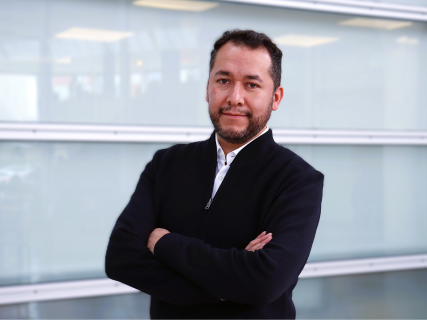
CIC biomaGUNE has opened a new line of strategic research focusing on the design of supramolecular inorganic structures, thereby offering great potential for developing new advanced therapeutic and diagnostic tools. The Donostia-based center for research in biomaterials has launched the new Supramolecular Inorganic Biosystems research group led by Dr Guillermo Moreno-Alcántar, who has recently joined the center, thanks to the Ramón y Cajal program of the Spanish Ministry of Science, Innovation and Universities.
The focus of the new lab is to design and study metal-containing supramolecular complexes with specific structural and functional properties. Systems of this type "operate on an intermediate scale between molecules and nanostructures", as the Ikerbasque Research Professor Aitziber L. Cortajarena, CIC biomaGUNE’s scientific director, remarked. The group’s lead researcher Dr Moreno-Alcántar himself explained that ”supramolecular chemistry can be defined as chemistry that goes beyond the molecule. This is important because many of the properties of matter around us depend on its supramolecular chemistry as much or more than on its structure at the molecular level”.
The research group devotes particular attention to metal-organic cages. These are molecular-level entities (approximately 1 nm) containing bonds between some metal atoms and organic structures (comprising mainly C and H). "These cages have a cavity inside which smaller molecules can be placed. Thanks to their design strategy, many structures of different sizes, shapes and chemical characteristics that favor the encapsulation of different guests inside the cavity can be generated," said Dr Moreno. ”This is a highly promising and still largely unexplored area of design," as Prof Cortajarena pointed out.
The new group aims to create inorganic architectures, particularly photoactive cages that can be used in areas such as photodynamic therapy, photocatalysis, and molecular detection. “We are particularly interested in integrating these metal-organic assemblages into biological systems to develop new therapeutic and diagnostic platforms,” said Moreno. “Our ultimate goal is to design artificial dynamic systems that can interact with, be coupled with, emulate, and ultimately adopt a function in biological systems to exploit the therapeutic possibilities of these interactions.”
Expanding the range of tools for designing therapeutic and diagnostic systems
Dr Moreno wants to “adapt the knowledge and tools developed by supramolecular chemistry to generate new therapeutic platforms that can be transferred to clinical practice, particularly in cancer treatment, but also in other health challenges, such as bacterial resistance to antibiotics". In the short term, the plan is to use metal-organic cages for the ‘smart’ delivery and release of therapeutic and diagnostic agents through the recognition of diseased cells by means of specific interactions. "In the long term, we can imagine systems that detect metabolic imbalances in cells associated with diseases such as cancer, and respond to them by activating processes that correct them or inhibit cell growth,” he added.
Dr Aitziber L. Cortajarena pointed out that this new line of research “positions CIC biomaGUNE at the cutting-edge of applying supramolecular cages in biomedical applications, with the potential to come up with innovative solutions for various current health problems. This line naturally complements our research center's capabilities in the development of functional biomaterials for biomedicine. Dr Moreno’s group is expanding the range of tools for designing therapeutic and diagnostic systems and is reinforcing the center's commitment to synthetic bioengineering as a means of finding new solutions to challenges in the biomedical field".
Dr Guillermo Moreno is very grateful that he has been able to join CIC biomaGUNE: "It is an exceptional center for developing research at the cutting edge of chemistry and materials science for biomedical purposes. The center has equipment that enables new therapeutic agents to be developed, from their synthesis and characterization at the molecular and supramolecular level to their evaluation in vitro and even in vivo. Integrating this capability requires a multidisciplinary team, and the center has personnel trained to exploit the entire infrastructure to the full. In addition to excellent research capabilities, I have found an extremely friendly community and a hugely stimulating environment with visits from colleagues from across the world, and that encourages creativity and promotes collaboration."