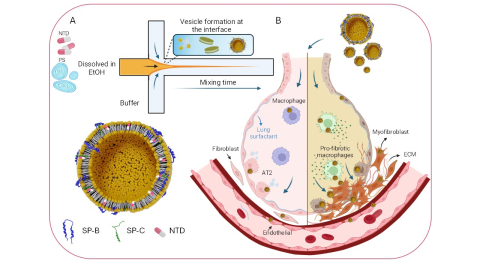
Although pulmonary drug delivery enables lung-targeted therapy, its clinical efficacy is often limited by inflammation, heterogeneous deposition, and physiological barriers such as mucociliary clearance and phagocytic uptake. Here, we report a biomimetic platform based on pulmonary surfactant nanoparticles (PSNPs) that preserves native surfactant proteins and biophysical functionality, resulting in enhanced pulmonary delivery. Microfluidic synthesis yielded highly uniform PSNPs with improved encapsulation efficiency and colloidal stability, while markedly increasing surfactant protein retention from 33% using conventional extrusion to 95% via microfluidics, corresponding to a 2.4-fold improvement. Functionally, PSNPs exhibited superior interfacial activity compared to lipid-only liposomes, increasing surface pressure from 5–10 mN/m to 25–30 mN/m, and achieved an approximately 80-fold enhancement in alveolar cellular uptake. In vitro, nintedanib-loaded PSNPs significantly reduced fibroblast migration, proliferation, collagen deposition, and TGF-β secretion relative to free drug and control formulations. In vivo, PSNPs demonstrated high pulmonary retention (95% injected dose per gram of lung tissue), efficient penetration into fibrotic regions, and minimal off-target accumulation in the liver (0.5%). Therapeutic efficacy was confirmed in a bleomycin-induced pulmonary fibrosis model, where PSNPs improved lung function and restored tissue architecture at doses as low as 0.5 mg/kg. Collectively, these results establish PSNPs as a robust lung-targeted nanotherapeutic platform, where microfluidic synthesis enables enhanced biomimicry, improved protein preservation, and superior therapeutic performance compared to conventional fabrication methods.