
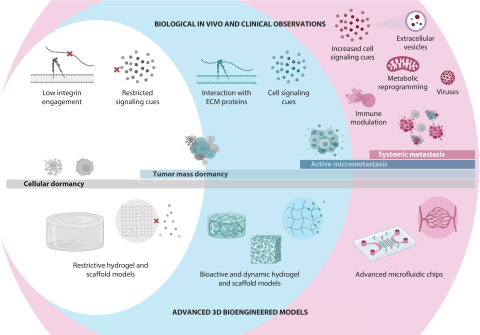
Cancer dormancy refers to an asymptomatic stage in cancer progression that contains residual disease. Cancer cells can disseminate from early tumors even before they are detectable, from advanced tumors, and from other metastases. Thus, cancer dormancy is a collective phenomenon, composed of single dormant cells that stopped dividing, tumor mass dormancy where cell proliferation is balanced by cell death, and active micrometastases. Dormancy evolves with complex spatiotemporal dynamics across length scales (from cell-intrinsic to cell-extrinsic interactions and microenvironmental regulation up to the body-wide systemic level) and across timescales (from single dormant cells to dormant tumor masses and active micrometastases), each responding differently to fluctuating microenvironments. Here we review biological in vivo and clinical observations of breast cancer dormancy across scales in length and time. Next, we outline 3D bioengineered models in which these different spatial and temporal scales are considered. Finally, we discuss challenges and opportunities of incorporating patient-derived cells. Collective cell behavior is an important aspect in cancer progression and, as such, modeling dormancy across scales in length and time could open new avenues to help us understand and predict the transition to active metastatic growth.
15/05/2026
Cancer Dormancy as a Collective Phenomenon Across Scales in Length and Time: Biological Observations and Advanced 3D Bioengineered Models
Title: Cancer Dormancy as a Collective Phenomenon Across Scales in Length and Time: Biological Observations and Advanced 3D Bioengineered Models
Journal: Annual Review of Cancer Biology 2026, DOI: 10.1146/annurev-cancerbio-070824-124153