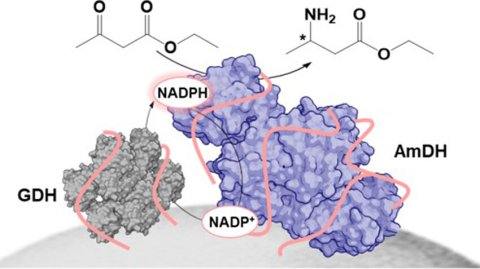
β-Amino esters are key intermediates in pharmaceuticals, polymers, and semisynthetic proteins; however, their enantioselective synthesis remains challenging. Amine dehydrogenases (AmDHs) enable atom-efficient reductive amination (ARA) using ammonia, but their stability limits process intensification. We identified two AmDHs from Cystobacter fuscus (an engineered variant W145A) and Streptomyces sp. that asymmetrically aminate β-keto esters using NAD(P)H. Both enzymes were coimmobilized with their cofactor and glucose dehydrogenase (GDH) on agarose-based macroporous beads coated with cationic polymers, generating self-sufficient heterogeneous biocatalysts (ssHB) requiring no external NAD(P)H. The most productive systems operated in packed-bed reactors to aminate ethyl acetoacetate continuously, reaching 90% yield and >99% ee (S). Space-time yield achieved a maximum of 12.1 g L-1 d-1. Yields declined after 24 h, dropping below 20%. Reducing the ammonium concentration from 1 to 0.2 M improved operational stability 4.2 times at the expense of productivity, which decreased 9-fold. These results support the development of robust self-sufficient amine dehydrogenase immobilized systems for reductive amination at low ammonium levels without added cofactors.