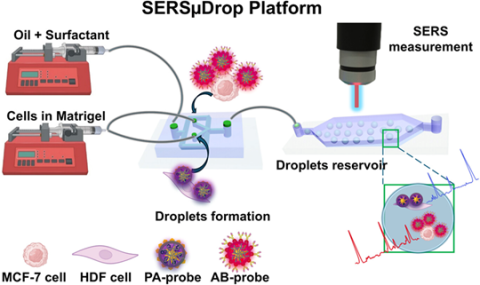
Cell–cell communication is a fundamental aspect of cellular physiology, with implications in early cancer detection, tumor progression, metastasis, and therapeutic resistance. One key mechanism driving intercellular communication involves extracellular vesicles (EVs), which facilitate the transfer of proteins, lipids, and nucleic acids between cells and play a critical role in modulating tumor behavior. Current tools to study EV-mediated communication lack the required spatial and temporal resolution to track EV exchange at single-cell level in physiologically relevant environments. This work introduces SERSµDrop, a microfluidic droplet-based platform integrating surface-enhanced Raman spectroscopy (SERS) for high-resolution monitoring of intercellular communication. In this work we co-encapsulate MCF-7 breast cancer cells and human dermal fibroblasts (HDF) in microdroplets and label them with gold nanostars (AuNSt) functionalized with distinct Raman reporters and surface coatings: poly-L-arginine hydrochloride (AuNSt@PA) for HDFs, and anti-CD81 antibodies (AuNSt@AB) to track small EV release from MCF-7 cells. SERS mapping reveals directional transfer of AuNSt@AB-tagged EVs from MCF-7 to HDFs over 4 days, while AuNSt@PA remains intracellular, confirming their limited exocytic behavior. The platform ensures high cell viability, preserves microdroplet integrity, supports high-throughput screening, and enables multiplexed detection, while minimizing SERS signal dilution through spatial confinement.