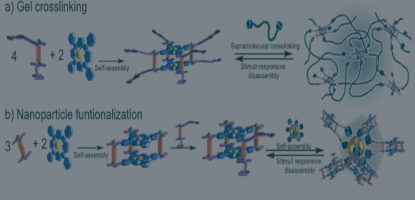
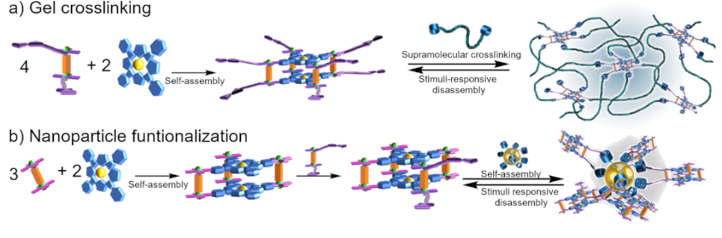
We have recently broadened the metallacages functionalization strategies by achieving the post-assembly functionalization of kinetically active metallacages.1 Our group works with systems based on kinetically robust and organometallic bonds, which allow the application of such functionalization strategies. One of our goals is to modify our cage systems with synthons, allowing for the supramolecular crosslinking of the systems into hierarchical materials (i.e., hydrogels and nanoparticles) using reversible host-guest interactions. In the medical setup, this can be used to control the administration and biodistribution of the MCgs. In the catalysis domain, the possibility of releasing and trapping MCg catalysts by transferring them from the solution state to a gel phase on demand is of practical importance for modulating the catalyst’s activity and allowing its recovery
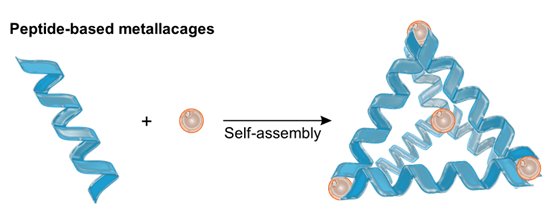
A second aim is to explore the use of biomolecules as ligands for constructing supramolecular systems to minimize collateral toxicity and enhance biocompatibility. Peptides are of particular interest, given the growing number of therapeutic peptides applied in cancer and other disease treatments. These molecules offer high selectivity, low toxicity, minimal immunogenicity, and cost-effective production. However, their intrinsic limitations, such as poor membrane permeability and limited stability due to the absence of secondary structure, remain significant challenges. To address these issues, we will design self-assembled structures that enhance peptide stability and promote cellular internalization. Furthermore, by incorporating peptides as MCgs building blocks, we aim to impart water solubility and overcome one of the main obstacles to their biomedical application.
Key publications
- Willnhammer, N.; Böhm, F.; Rieder, L.; Bogenberger, D.; Krauss, D.; Moreno-Alcántar, G.; Casini, A. Post-assembly modification of Pt(II) metallacages: an open door to medicinal applications. ChemRxiv 2025, https://doi.org/10.26434/chemrxiv-2025-59j0m.