
• The CIC biomaGUNE group led by Jordi Llop is investigating Alzheimer’s disease from a different angle: focusing on myelin, the protective sheath around the nerve fibres through which nerve impulses are transmitted.
• A better understanding of the role of myelin opens up new possibilities for the early detection and monitoring of the disease and for finding new therapeutic strategies.
San Sebastián, 16 September 2026. For decades, research on Alzheimer’s disease has been focused on two main protagonists — a protein fragment known as amyloid beta, which is deposited in the space between the neurons (the cells responsible for transmitting information) in individuals with Alzheimer’s, and the tau protein, which builds up inside the neurons in this pathology. However, there are increasing indications that these two pieces of the puzzle are not sufficient for understanding the disease.
Different studies have suggested that the myelin sheath (the fatty layer that acts as insulation for the nerves and facilitates rapid communication between the neurons) could be damaged in early stages of Alzheimer’s, even before symptoms become apparent.
“There has been a shift in perspective in recent years, with an emphasis on the possible role of myelin degradation in the progression of the disease. It is believed that these changes in the myelin occur in the very early stages of the disease”, explains Jordi Llop at CIC biomaGUNE. In people with Alzheimer’s, the myelin is damaged, deformed in some way. However, it is not known whether this is the cause or the consequence of the disease.”
The Radiochemistry and Nuclear Imaging research group at CIC biomaGUNE, led by Llop, in collaboration with Carlos Matute’s group at the University of the Basque Country (EHU), is working to find a way to repair or prevent changes to the myelin, as a strategy for treating Alzheimer’s disease. “The ultimate aim of our project is to investigate whether there are compounds that may help restore the myelin in our Alzheimer’s mouse model and whether this results in a cognitive improvement over time”, adds Llop.
Making the invisible visible
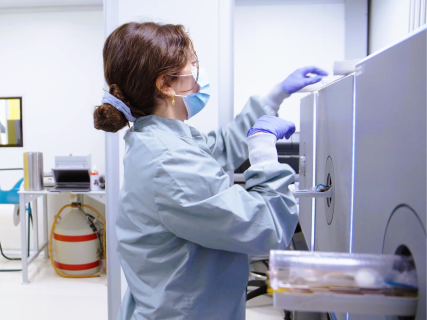
Changes in the myelin are not easy to detect. Although brain imaging techniques allow observation of the brain without the need for surgery, they do not always capture subtle changes in the myelin, which is why much of the degradation may remain hidden. CIC biomaGUNE has a new generation of tools that “allow us to see in real time whether it is possible to repair myelin sheaths in animal models that simulate what is happening over the course of the disease”, explains Llop. We perform real-time imaging tests to see how the myelin sheath surrounding the neurons is protected, and combine these with performance tests to see whether the mice recover memory or lose less memory.”
Positron emission tomography (PET) is an imaging technique that uses small radioactive molecules that act as markers. Once inside the organism, the molecules move around the brain and allow the detection of certain biological processes. To investigate Alzheimer’s disease, “we are using a marker that can indicate areas in the brain where the myelin is damaged. When the myelin deteriorates, it reveals structures that are normally hidden. The marker binds to these structures and creates a detectable signal. It is as if the brain were using invisible ink to reveal the areas where something is starting to go wrong”, says Mariana Coimbra de Almeida, a predoctoral researcher in the group.
The team at CIC biomaGUNE is also trying to automate some of the processes used to analyse the images obtained in their studies. To this end, predoctoral researcher Sebastián Acebal is developing artificial intelligence models: “To know what is happening in the brain, one of the key aspects is knowing what is happening in each area. For this, we divide the images obtained by my colleagues and define the areas of interest. This process is known as segmentation. It is usually carried out manually, but is a lengthy and complicated process. As part of my PhD project I am developing different artificial intelligence models that will automate the process, as well as other programs and software to enhance the results obtained”, explains Acebal.
Early detection and monitoring of the disease, and new therapeutic strategies
Early studies using these types of tools show that it is possible to detect changes in the brain associated with Alzheimer’s disease in areas where myelin is abundant. This supports an idea that is gaining ground: Alzheimer’s disease is not only an accumulation of protein deposits, but also a connection problem. Neurons do not function in isolation. They form complex networks and their efficiency depends on signals being transmitted properly. If the myelin is damaged, these networks become less efficient, even though the neurons are still present.
The MYAMI project is looking to find new treatments for Alzheimer’s disease. “A better understanding of the role of myelin opens up new possibilities”, says Llop. This could help detect Alzheimer’s disease in the earlier stages, when changes are not yet clinically evident. It would also allow a more precise monitoring of disease progression, as well as opening the door to new therapeutic strategies. If part of the problem is the deterioration of the myelin, then protecting or repairing it could become a key objective.
About the MYAMI project
MYAMI (Myelin Dysfunction in the Pathogenesis of Alzheimer’s Disease: Evaluation of new therapeutic strategies using molecular imaging) is a project funded by the Spanish Ministry of Science, Innovation and Universities, the State Research Agency and the European Social Plus Fund.
About CIC biomaGUNE
The Centre for Cooperative Research in Biomaterials, CIC biomaGUNE, a member of the Basque Research and Technology Alliance (BRTA), is a non-profit research organisation in San Sebastian that carries out cutting-edge research at the interface between chemistry, biology and physics, with a particular focus on the study of the molecular-scale properties of biological nanostructures and their biomedical applications. In 2018, it was accredited as a María de Maeztu Unit of Excellence, for meeting the excellence criteria of having a significant impact and high level of competitiveness in its field of activity in the global scientific community.
About Ikerbasque
Ikerbasque, the Basque Foundation for Science, is the result of an initiative by the Department of Science, Universities and Innovation of the Basque Government. Its aim is to strengthen commitment to scientific research by attracting, retaining and developing outstanding researchers from around the world. Today, it is a well-established organisation with 402 researchers who carry out their work in all areas of knowledge.