
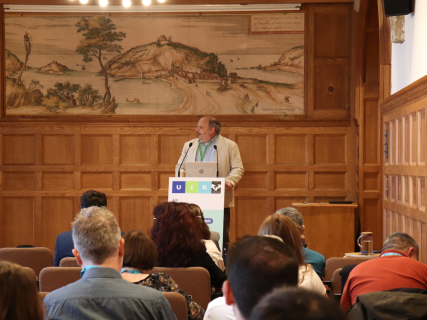
The international congress on nanomedicine SAHMN 2026 (Self-Assembled Hybrid Materials in Nanomedicine: From Non-Viral Vectors to Cancer Therapy and Neurostimulation), organized by Dr Sergio Moya, researcher and leader of the group at the CIC biomaGUNE research center, will be taking place from 25 to 27 February.
The scientific event will be bringing together international experts in materials sciences, chemistry, biology, biomedical engineering and biophysics to share, at the Miramar Palace, the latest results of their research with applications in biomedicine. “The latest advances in gene therapy technologies will be reported on, and we will be exploring how these innovations can shape the future of cancer treatment,” explained Moya.
Over the three days there will be presentations of various research projects featuring some focused on the development of cancer therapies based on supramolecular gene vectors using polymers, cancer therapies based on bacteria modified with polymers, neurostimulation with nanomaterials, and the development of synthetic blood with nanoparticles containing hemoglobin nuclei.
A revolutionary approach to cancer treatment
In this context, the results of the SUPRO-GEN project, focused on designing new gene vectors for cancer therapies, will be shared. This project, led by Dr. Moya, has been funded by European funds within the framework of the Marie Sklodowska Curie ‘RISE’ action for Research and Innovation Staff Exchange, which aims to strengthen international cross-sector collaboration in R&D&i through exchanges of research and innovation staff between public and private bodies in order to better address global challenges. The SUPRO-GEN project, which has taken four and a half years and has involved collaboration between different universities and research centers in eight countries, sought to design “new polymeric vectors with low toxicity and high efficacy for gene therapies to combat cancer and offer an alternative to the viral vectors routinely used in this type of therapy”, said the CIC biomaGUNE researcher. “We’re talking about a revolutionary approach to cancer treatment.”
Gene therapies entail stopping or altering the expression of a specific gene and can be used in various types of cancer. If gene therapies are to reach cells and perform their function, they must be inserted into a kind of vehicle that protects them and helps them reach their destination. In biology, these vehicles are known as vectors.
The most common are viral vectors, which make use of the shell (capsid) of a virus. Although they are highly effective, viral vectors pose some disadvantages that make it necessary to continue to explore other alternatives. For example, their load capacity is limited, they are difficult to produce on a large scale, and can cause unwanted genetic changes.
Non-viral vectors, on the other hand, are less effective in their ability to deliver gene therapy to cells, but they are safer, less expensive to produce, and offer more options for modification. In this respect, the SUPRO-GEN project has constituted a step forward in the development of new vectors using different materials, the properties of which will continue to be explored.
Gene therapies entail stopping or altering the expression of a specific gene and can be used in various types of cancer. If gene therapies are to reach cells and perform their function, they must be inserted into a kind of vehicle that protects them and helps them reach their destination. In biology, these vehicles are known as vectors.
The most common are viral vectors, which make use of the shell (capsid) of a virus. Although they are highly effective, viral vectors pose some disadvantages that make it necessary to continue to explore other alternatives. For example, their load capacity is limited, they are difficult to produce on a large scale, and can cause unwanted genetic changes.
Non-viral vectors, on the other hand, are less effective in their ability to deliver gene therapy to cells, but they are safer, less expensive to produce, and offer more options for modification. In this respect, the SUPRO-GEN project has constituted a step forward in the development of new vectors using different materials, the properties of which will continue to be explored.